

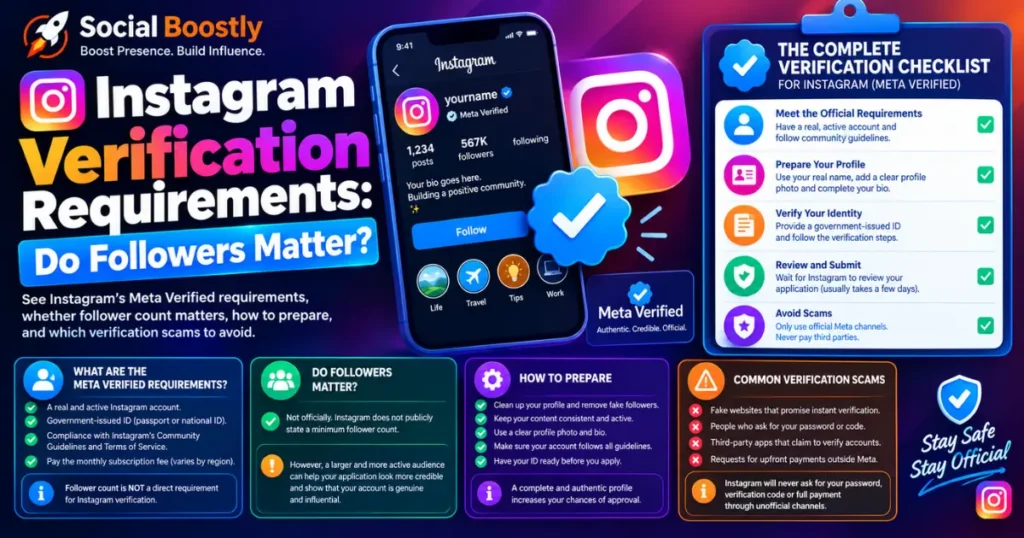
Instagram verification is not mainly about follower count. There are two routes to a verified badge, and each has its own requirements: a paid subscription called Meta Verified, which checks your identity, and a badge for accounts Meta considers notable. Meeting the requirements for the first is a matter of identity and profile details, while the second is about being genuinely well known.
This guide explains both routes, where follower count fits, how to prepare, and why buying followers is not a way to qualify.
The two routes to a verified badge
Instagram describes verification in two different ways, and they aren’t interchangeable.
| Meta Verified | Notability-based verification | |
|---|---|---|
| What it is | A paid subscription that confirms your identity with a government ID | A badge for accounts Instagram considers authentic and notable |
| Who it suits | Creators and, in some regions, businesses who want their identity confirmed | Well-known people and brands |
| What decides it | Meeting the eligibility requirements and confirming your identity | Whether the account is genuinely well known and searched for |
| What you pay | A subscription, with features and pricing that vary by region | The badge itself isn’t sold |
Meta describes Meta Verified as a subscription that gives creators verification with a government ID, account protection and direct account support, and says features, availability and pricing vary by region. Accounts that already have a verified badge from the earlier requirements aren’t changed, and can still sign up for Meta Verified if they qualify, according to Meta’s Meta Verified page.
For most small creators and businesses, Meta Verified is the route that is realistically open. The notability route depends on how widely known you already are, which no setting or tactic changes quickly.
Meta Verified requirements
Instagram’s Help Center lists the eligibility requirements for a Meta Verified profile as of this writing:
| Requirement | What it means |
|---|---|
| Age | You must be at least 18 |
| Profile name | A public or private profile associated with your full name, which aligns with Instagram’s naming standards |
| Profile photo | A profile picture that includes your face |
| Activity | Minimum activity requirements, such as prior posting history |
| Identity | A government-issued ID that matches your profile name and profile picture |
| Security | Two-factor authentication turned on |
| Rules | You follow Instagram’s Terms of Use and Community Guidelines |
Two more details from Meta are worth knowing before you apply. In some regions you may also be asked to submit a selfie video to confirm your identity. And once your profile is verified, you can’t change your username or date of birth without going through the Meta Verified subscription and verification process again.
Notice what the list doesn’t include: there is no follower minimum.
So where does follower count fit?
For Meta Verified, the published requirements don’t set a follower minimum. What they ask for is a real person with a matching ID, a genuine profile and a record of activity. A small account that meets those can qualify, and a large one that doesn’t match its ID cannot.
Follower count plays a different role in the notability route. There, the question is whether the account is well known and highly searched for, and Instagram looks at things like press coverage, not at a follower total on its own. Followers can be a side effect of being notable, but they don’t create notability.
So the honest answer is:
- For Meta Verified: follower count doesn’t determine eligibility. Identity, profile details and activity do.
- For notability: follower count isn’t the test. Public recognition is.
- For both: a credible profile with real posts and real engagement supports your application far more than a bigger number does.
If you want to read more about how numbers are judged, see our guide on whether follower count really matters.
Prepare your account: a checklist
Get these right before you apply, because Meta checks that your profile matches your ID.
- Match your name to your ID. Your profile name should line up with the name on your government ID, allowing for the variations Instagram accepts.
- Use a clear photo of your face. The photo should resemble the one on your ID.
- Decide on your final username and name first. After verification you can’t change your username or date of birth without repeating the process.
- Turn on two-factor authentication.
- Have a posting history. A profile with several real posts shows the activity requirement.
- Complete your bio and links. A clear description of who you are and what you do makes the account look genuine.
- Be at least 18 and have a valid government-issued ID ready.
- Check you’re following the rules. An account with Community Guidelines issues is a weak candidate.
- Avoid last-minute edits. Don’t change your name or photo repeatedly right before you apply.
- Check the price in your region. Meta says pricing and features vary, so confirm what the subscription costs where you live.
If you’re a business rather than an individual, check what Meta currently offers for businesses, since the individual requirements above assume a person’s full name and personal ID.
Scams and mistakes to avoid
Verification attracts a lot of bad actors and bad advice. Watch for these:
- Anyone selling a badge. Meta’s own subscription is the paid route. A third party offering to “get you verified” for a fee, or to send you a badge, is not something Meta supports. Never share your password or login codes.
- Fake verification messages. Phishing messages claiming your account is “eligible” or “at risk” and asking you to click a link or pay are a common scam. Check the application only inside the Instagram app.
- Paying for fake press. Instagram’s guidance on notability is about genuine coverage, and paid or promotional content doesn’t count.
- Buying followers to qualify. There is no follower minimum for Meta Verified, so there is nothing to gain, and a sudden jump with no engagement can make an account look less credible.
- Changing your profile name or photo repeatedly. Keep your details stable and consistent with your ID.
- Using a pseudonym or brand name for a personal subscription. Meta Verified for individuals needs a name and ID that match, so brand-only or alias profiles don’t fit that route.
- Assuming the badge brings reach. Verification confirms identity. It isn’t a promise of more followers, engagement or sales.
Where follower growth services fit, and where they don’t
Because Meta Verified has no follower minimum, adding followers does nothing for that route. It also doesn’t create the public recognition the notability route looks for, so a purchased count isn’t a way to qualify for either.
Some people still add followers for a different reason, such as making a new profile look less empty. If you’re considering it, keep these limits in mind:
- It raises a visible number and nothing else. Social Boostly’s Instagram Followers page states that purchased followers don’t guarantee engagement, reach, sales or organic growth.
- Instagram’s rules discourage it. Artificially boosting engagement can lead to follower drops or account action, and a restricted account is a weak candidate for verification.
- It can lower your engagement rate, which can make a profile look less credible rather than more.
For reference, Instagram followers at Social Boostly were $15.00 per 1,000 with a minimum order of 100 as of October 12, 2026, per the live Instagram Followers page, and delivery usually starts within 0–60 minutes of payment confirmation. For a closer look at risk and cost, see our guides on whether buying Instagram followers is safe and how much Instagram followers cost.
If verification is your goal, put your effort into the profile, the activity and the identity details instead.
Frequently asked questions
How many followers do I need to get verified on Instagram?
For Meta Verified, Instagram’s published requirements don’t list a follower minimum. They ask for an adult account with a matching name, face photo, government ID, two-factor authentication and some activity history.
What are the requirements for Meta Verified on Instagram?
You need to be at least 18, have a profile with your full name and a photo of your face, meet minimum activity requirements, provide a government ID that matches your profile name and photo, turn on two-factor authentication and follow Instagram’s rules.
Can I buy followers to get verified?
No. There is no follower minimum for Meta Verified, so it wouldn’t help, and Instagram’s rules discourage artificial engagement.
Does verification increase reach or followers?
Not by itself. Verification confirms identity, and Meta says features and benefits vary by region. It isn’t a promise of reach or sales.
What can’t I change after I’m verified?
Meta says you can’t change your username or date of birth after verification without going through the subscription and verification process again, so settle those first.
What to do next
If you want a verified badge, focus on what the requirements actually ask for: a profile that matches your ID, a clear face photo, two-factor authentication, a real posting history and a clean record. Check the current requirements and price in your region on Instagram Help before you apply.
If you’d like to look at Social Boostly’s Instagram options, you can browse the Instagram services hub or the Instagram Followers page and read the scope notes on each. You can also read our guide on how to get more Instagram followers, or contact the team with questions.
Verification requirements are as published on Instagram Help and may change. Prices are as of October 12, 2026 and may change. Results may vary. Platform rules and terms apply.