

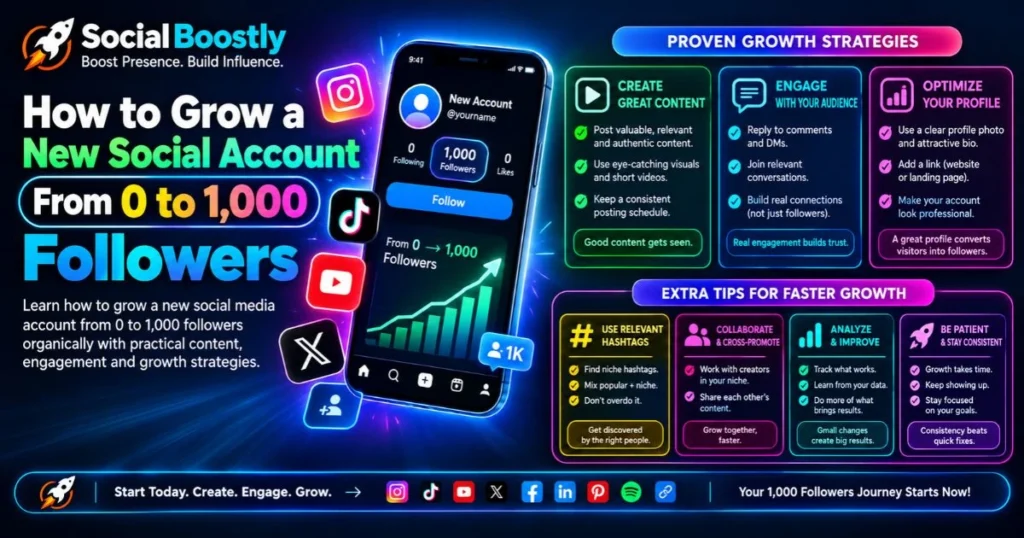
The first 1,000 followers are the hardest, and the reason is simple: a new account has no social proof, no history with the algorithm, and nothing for a stranger to judge except a handful of posts. The good news is that 1,000 is a small enough number to reach with a plan and a few weeks of steady work, on almost any platform. This guide lays out that plan in the order that makes sense: set the account up properly, choose a lane, post on a rhythm you can keep, talk to people, borrow other audiences, and measure what works.
No platform publishes an exact formula for who gets shown to whom, so treat every number below as a planning guide, not a promise.
What 1,000 followers actually takes
Before the steps, set expectations. Growth from zero is slow at first and then speeds up once a few posts do well. A realistic range for a consistent, active account looks like this:
| Pace | What it looks like | Rough timeline |
|---|---|---|
| Slow and steady | 3 posts a week, a little engagement each day | 4 to 8 months |
| Committed | 5 to 7 posts a week, 20 to 30 minutes of daily engagement | 2 to 4 months |
| Breakout | One or two posts that travel well, plus the committed routine | A few weeks, but it can’t be planned |
These are ranges based on common creator experience, not guarantees. Niche, platform, format and plain luck all move them.
Step 1: Set the account up so a stranger says yes
Most visitors decide in about three seconds whether to follow. Fix the things they see first.
- Name and handle: short, easy to spell, and the same on every platform you use.
- Photo: a clear face or a simple logo that still reads at thumbnail size.
- Bio: one line saying who you help or what you post, plus one line of proof or personality. “Weekly budget meals for students” beats “Food lover | Dreamer”.
- Link: one link only, pointing somewhere useful.
- Starter content: have 9 to 12 posts live before you promote anything, so a new visitor sees a feed with substance and not an empty grid.
Step 2: Pick one lane and stay in it
Accounts that try to cover everything are hard to follow, because the visitor can’t predict what they’ll get. Pick a narrow topic and a clear audience.
A useful test: finish the sentence “Follow me if you want ___.” If the blank is vague (“inspiration”), narrow it. If it’s specific (“simple home workouts with no equipment”), you have a lane.
Small niches are an advantage when you’re starting out. It’s easier to become the obvious account for a small topic than a forgettable one in a huge category.
Step 3: Build a posting rhythm you can keep
Consistency matters more than volume. A schedule you hold for three months beats a burst of daily posting that collapses after two weeks.
- Choose a frequency you can sustain, such as three to five posts a week.
- Batch your work. Film or write several posts in one sitting, then schedule them.
- Rotate three kinds of posts:
- Value posts that teach or solve a small problem.
- Personality posts that show who you are and why you care.
- Shareable posts that make someone want to send them to a friend.
- Repeat what works. When a post beats your average, make a close cousin of it the next week.
Short video is the format most platforms are pushing for discovery right now, so if you can only master one thing, a clear 15 to 40 second video with a strong first line is a good bet. Check each platform’s own creator guidance for current specifics, since they change.
Step 4: Spend as much time engaging as posting
Posting alone rarely builds an audience from zero. Conversation does.
- Spend 20 to 30 minutes a day commenting on accounts in your niche, especially those a little bigger than you. Say something specific enough that it couldn’t be pasted onto any post.
- Reply to every comment on your own posts, ideally within the first hour.
- Answer questions in your niche on the platform, and turn good ones into posts.
- Follow and interact with people who already engage with your topic, but avoid mass-following and unfollowing, which most platforms treat as spam-like behavior.
Step 5: Borrow other audiences
You don’t have to build every follower from nothing.
- Collaborate with creators at a similar size: joint posts, shoutouts, duets or guest appearances. You each reach the other’s audience.
- Be useful where your audience already is. Forums, communities and groups on your topic send visitors to a profile that helps them.
- Cross-post carefully. Share a version of your best content on a second platform, adjusted to that platform’s format, and point people back to your main account.
- Use your existing channels. Put the handle on your website, email signature and other profiles.
Step 6: Track what matters, and ignore what doesn’t
Follower count alone tells you little. Watch these instead:
| Metric | What it tells you |
|---|---|
| Reach from non-followers | Whether the platform is showing you to new people |
| Saves and shares | Whether content is useful or share-worthy |
| Profile visits per post | Whether posts make people curious about you |
| Follow rate (new followers divided by profile visits) | Whether your bio and feed convert interest into a follow |
Every two weeks, look at your top three posts and your bottom three. Make more like the top, stop making the bottom.
Common mistakes that stall growth
- Posting in bursts and then disappearing for weeks.
- A feed that doesn’t match the bio, so visitors leave without following.
- Chasing trends unrelated to your niche, which brings viewers who don’t care about your topic.
- Ignoring comments, which are one of the cheapest growth tools you have.
- Judging by one post. One flop tells you nothing, and one hit doesn’t guarantee a repeat.
- Comparing yourself with accounts that started years earlier.
Where paid growth fits in
Some people supplement organic work with purchased followers or engagement, usually to make a new profile look less empty. If you consider it, be clear about the trade-offs: platform rules restrict artificially inflated numbers, purchased followers don’t create real interest, and they can distort your engagement rate. We cover the risks in our guide on whether buying Instagram followers is safe. If you do decide to use a service, keep it small, never share your password, and treat it as a supplement to real content, not a replacement. You can see current options for Instagram followers and TikTok followers on the order pages.
A simple 30-day starter plan
Week 1: Finalize your name, photo, bio and link. Choose your lane. Publish your first 9 to 12 posts.
Week 2: Start a posting schedule you can keep. Spend 20 minutes a day commenting in your niche. Reply to every comment you get.
Week 3: Reach out to two or three creators at a similar size about a collaboration. Post in one community where your audience gathers.
Week 4: Review your top and bottom posts. Double down on what worked. Adjust the schedule if it’s too heavy to keep up.
Frequently asked questions
How long does it take to reach 1,000 followers?
For a consistent, active account it commonly takes a few months, but the range is wide. Niche, platform and one or two breakout posts matter a lot.
How often should I post?
As often as you can keep up for months. Three to five quality posts a week is a reasonable starting point.
Do hashtags still matter?
They can help platforms understand your topic, but they’re a small factor next to the quality of the post and how people respond to it. Use a few relevant ones and skip long blocks of unrelated tags.
Should I be on every platform?
No. Master one, then expand. Spreading yourself thin early usually slows everything down.
Do follow-for-follow groups work?
They inflate the number but usually bring an audience that doesn’t engage, which can hurt your reach. Followers who care about your topic are worth more than a bigger count.
When should I think about promotion?
Once you have a consistent posting rhythm and content you’re proud of. Promotion amplifies what exists; it can’t create interest that isn’t there.