

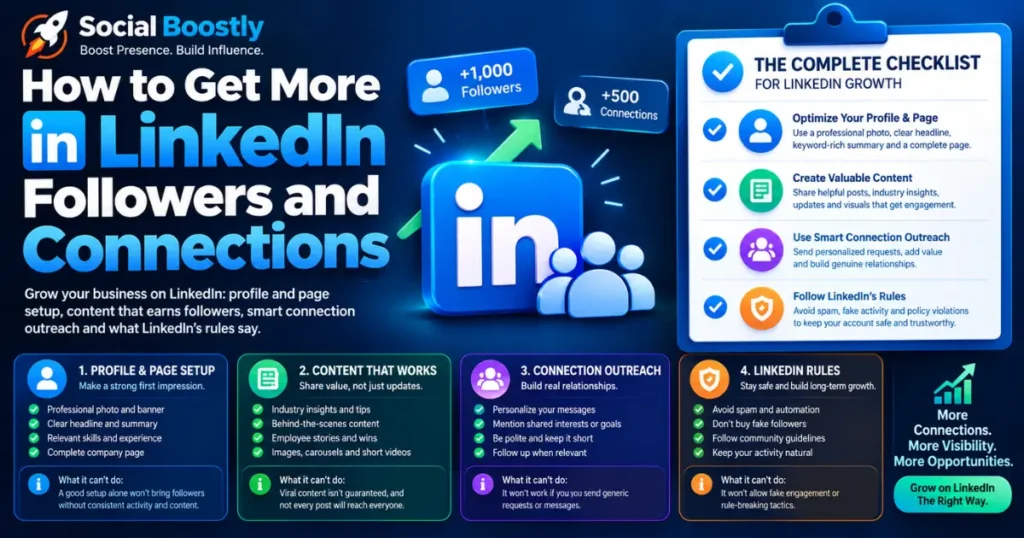
Getting more LinkedIn followers starts with giving people a reason to follow you. A clear professional profile, useful content, relevant conversations and consistent activity can help you attract the right audience. Whether you want to grow a personal profile or a company page, focus on reaching professionals who are genuinely interested in what you share.
This guide explains 12 practical ways to increase LinkedIn followers, build meaningful professional connections and measure your progress.
Quick Answer: How Can You Get More LinkedIn Followers?
To grow your LinkedIn following:
- Optimize your profile or company page.
- Write a clear headline and About section.
- Publish useful, original content consistently.
- Share industry knowledge and practical advice.
- Engage with relevant LinkedIn discussions.
- Invite relevant first-degree connections to follow your company page.
- Use LinkedIn newsletters and events.
- Encourage employees to share company updates.
- Promote your LinkedIn presence through your website and email.
- Review analytics and improve your content strategy.
- Build relationships with relevant professionals.
- Focus on audience quality instead of follower count alone.
1. Understand LinkedIn Followers vs Connections
Before working on LinkedIn growth, understand the difference between followers and connections.
| Feature | LinkedIn Followers | LinkedIn Connections |
|---|---|---|
| Relationship | One-way | Mutual |
| Approval required | No connection approval needed | Invitation must be accepted |
| Main purpose | Following public content | Building professional relationships |
| Messaging | Depends on LinkedIn messaging permissions | Direct messaging is generally available |
| Best suited for | Creators, professionals and public profiles | Networking, collaboration and business relationships |
A follower can see your public content without becoming a first-degree connection. A connection is a mutual professional relationship.
For creators and professionals who publish regularly, growing followers can help build an audience. For businesses, both a strong company page and relevant personal networks can support brand visibility.
2. Optimize Your LinkedIn Profile
Your profile is often the first place people visit after discovering your content.
Make sure it communicates who you are, what you do and why someone should follow you.
Use a Professional Profile Photo
Choose a clear, recent photograph that represents you professionally. Avoid blurry images, distracting backgrounds and photographs that make it difficult to recognize you.
Create a Relevant Headline
Your headline should explain your professional role and expertise.
For example:
Instead of:
Marketing Professional
Try:
Digital Marketing Specialist | SEO & Content Strategy | Helping Businesses Improve Online Visibility
Make sure your headline accurately represents your experience.
Improve Your About Section
Use the About section to explain:
- Your professional background.
- Your areas of expertise.
- The people or businesses you help.
- The subjects you regularly discuss.
- Your professional interests.
Write naturally instead of filling the section with repeated keywords.
Add Relevant Featured Content
Show visitors useful resources such as:
- Case studies.
- Professional projects.
- Articles.
- Presentations.
- Portfolio examples.
- Industry insights.
A well-organized profile gives visitors more context and helps them decide whether your content is relevant.
3. Complete and Improve Your LinkedIn Company Page
If you manage a business, your LinkedIn company page should have complete and accurate information.
Include:
- Company logo.
- Cover image.
- Business description.
- Website address.
- Industry.
- Company size.
- Location.
- Relevant specialties.
Write a clear description explaining what the business offers and who it serves.
Use your company page to publish company updates, educational content, project highlights, announcements and industry information.
An active, informative page gives potential followers a reason to stay connected with your brand.
4. Publish Valuable Content Consistently
Content is one of the most useful ways to attract an interested LinkedIn audience.
Choose two or three topics that match your professional expertise.
For example, a digital marketing agency might publish about:
- Search engine optimization.
- Website development.
- Social media marketing.
- Conversion optimization.
- Business growth strategies.
Focus on helping your audience solve actual problems.
Useful content formats include:
Educational posts: Explain a concept or share a practical lesson.
How-to guides: Break a complicated process into simple steps.
Case studies: Explain a real project, the approach used and the outcome.
Industry insights: Discuss relevant developments with supporting information.
Professional experiences: Share lessons learned from genuine work experiences.
Consistency matters more than publishing large quantities of low-value posts.
5. Write Strong LinkedIn Post Openings
The opening lines help readers understand why they should continue reading.
Avoid starting every post with generic statements.
Instead, try an informative opening:
“Your website may be getting visitors but still losing potential customers. Here are five things worth checking.”
Or:
“Many businesses invest in SEO without understanding what happens after someone clicks their website.”
Follow the opening with useful explanations, examples or practical steps.
Keep paragraphs readable and make sure the post delivers what its opening promises.
6. Use Different LinkedIn Content Formats
Experiment with formats that suit your audience and subject.
| Format | Suitable content |
|---|---|
| Text posts | Opinions, experiences and short lessons |
| Document posts | Checklists, guides and educational presentations |
| Images | Project highlights, charts and visual explanations |
| Videos | Tutorials, demonstrations and interviews |
| Newsletters | Regular industry knowledge and long-form insights |
| Polls | Relevant audience questions and feedback |
Do not assume one format will always perform best.
Review your analytics to understand which formats attract the most relevant audience.
7. Engage With Relevant Professionals
LinkedIn is a professional networking platform, so meaningful conversations are important.
Identify professionals, businesses and industry communities relevant to your work.
You can:
- Comment thoughtfully on industry posts.
- Answer questions related to your expertise.
- Share useful perspectives.
- Participate in relevant professional discussions.
- Congratulate people on genuine achievements.
- Respond to comments on your own content.
Avoid generic comments and repetitive promotional messages.
A thoughtful contribution can introduce your profile to people who may be interested in your expertise.
8. Invite Relevant People to Follow Your Company Page
LinkedIn provides a built-in invitation feature for company pages.
Page administrators can invite eligible first-degree connections to follow their company page.
To use this feature:
- Open the LinkedIn company page you manage.
- Access the administrator view.
- Find the Invite to follow option.
- Review the available connections.
- Invite people who are likely to be interested in your business.
LinkedIn provides monthly invitation credits, and limits can vary.
LinkedIn Premium Company Pages also offer additional invitation features, including invitations to eligible people who have engaged with page content.
Always follow the available invitation limits and avoid sending irrelevant invitations.
Official reference: LinkedIn Help – Invitations to follow a LinkedIn Page.
9. Encourage Employee Advocacy
Employees can help introduce your company page to relevant professional audiences.
Encourage team members to:
- Follow the official company page.
- Share relevant company updates.
- Discuss projects they genuinely contributed to.
- Share professional knowledge.
- Participate in industry discussions.
Employee posts should reflect their real experiences and opinions.
Do not require employees to publish repetitive promotional messages or artificial engagement.
The objective is to expand genuine awareness of the business.
10. Use LinkedIn Newsletters and Events
LinkedIn newsletters can help you publish recurring content around a specific subject.
For example, a digital marketing agency could create a monthly newsletter covering SEO developments, website optimization and marketing strategies.
To make a newsletter useful:
- Choose a clear topic.
- Write informative headlines.
- Publish useful, original information.
- Maintain a realistic publishing schedule.
- Share new editions with relevant audiences.
LinkedIn Events can also help professionals and businesses connect with people interested in webinars, workshops and industry discussions.
Official reference: LinkedIn Help – Newsletter Best Practices.
11. Promote Your LinkedIn Profile Outside LinkedIn
Your LinkedIn presence does not need to depend entirely on the platform itself.
You can introduce your profile or company page through existing communication channels.
Consider adding a LinkedIn link to:
- Your website.
- Email signature.
- Professional portfolio.
- Business presentations.
- Company newsletters.
- Relevant social media profiles.
- Digital business cards.
For businesses, include a LinkedIn follow invitation in relevant company communications.
Keep the invitation natural and make sure it is useful to the recipient.
12. Review LinkedIn Analytics and Improve Your Strategy
Publishing content without measuring its performance makes it difficult to understand what your audience values.
Review your analytics regularly.
| Metric | What it helps you understand |
|---|---|
| Follower growth | Whether your audience is increasing |
| Post impressions | How frequently content is displayed |
| Engagement | How people interact with your posts |
| Comments | Whether content encourages discussion |
| Reposts | Whether people share your content |
| Profile views | Whether people are exploring your professional identity |
| Follower demographics | Whether your audience matches your target market |
For company pages, LinkedIn provides follower, visitor and content analytics.
For personal profiles, use the analytics available in your account.
Compare performance over consistent time periods instead of judging your strategy from one post.
Official reference: LinkedIn Page Analytics.
LinkedIn Followers vs Genuine Professional Growth
A larger follower count is not automatically proof of a successful LinkedIn presence.
Consider what you actually want to achieve:
- More relevant professional relationships.
- Better awareness of your expertise.
- Meaningful discussions.
- Business enquiries.
- Career opportunities.
- An interested audience for your content.
Artificial followers, fake accounts, automated engagement and services that manipulate platform activity can put accounts at risk.
LinkedIn explicitly prohibits fake engagement and unauthorized tools or services that manipulate activity on its platform.
For sustainable growth, focus on authentic relationships, useful content and professional credibility.
Official reference: LinkedIn Help – Prohibited Software and Extensions.
A Practical 30-Day LinkedIn Growth Plan
Here is a simple starting schedule for improving your LinkedIn presence.
| Period | Activities |
|---|---|
| Days 1–5 | Optimize your profile or company page |
| Days 6–10 | Identify content topics and prepare useful posts |
| Days 11–15 | Publish educational content and participate in relevant discussions |
| Days 16–20 | Share professional experiences and useful resources |
| Days 21–25 | Review analytics and identify successful content |
| Days 26–30 | Improve your content strategy and plan the next month |
The exact results will depend on your audience, content quality, consistency and professional niche.
Frequently Asked Questions
How can I get more followers on LinkedIn?
Optimize your profile, publish useful content, participate in relevant discussions, build professional relationships and encourage interested people to follow your updates. For company pages, use LinkedIn’s official invitation features where available.
How do I get followers on LinkedIn without sending connection requests?
People can follow your public LinkedIn content without becoming your first-degree connections. Publish useful public posts, participate in industry discussions and make your profile easy to discover.
What is the difference between LinkedIn followers and connections?
Followers can see your public content without necessarily having a mutual relationship with you. Connections are first-degree professional relationships that require an accepted invitation.
How can I grow a LinkedIn company page?
Complete your company information, publish relevant updates, share useful resources, invite relevant first-degree connections and encourage employees to share genuine company content.
How often should I post on LinkedIn?
Choose a publishing schedule you can maintain while producing useful content. Start with two or three quality posts per week and adjust according to audience response and available resources.
Why are my LinkedIn followers not increasing?
Possible reasons include an incomplete profile, unclear content topics, inconsistent publishing, limited participation in relevant discussions or content that does not match your intended audience. Review your analytics and test improvements gradually.
Does having more LinkedIn followers guarantee more leads?
No. Followers do not automatically become customers. Relevant audiences, useful content, professional credibility and a clear business offering are important for generating meaningful enquiries.
How can I check my LinkedIn follower growth?
Use LinkedIn’s available audience or Page analytics to review follower totals, new followers and audience demographics over time.
Final Thoughts
Growing your LinkedIn following is a long-term process. Start by improving your professional profile, identifying the audience you want to reach and publishing information that genuinely helps them.
Build relationships through meaningful conversations, use LinkedIn’s official features and review your analytics regularly.
Instead of focusing only on follower numbers, aim to develop a professional audience that values your experience, content and business.
Related resource: Explore our LinkedIn platform resources for more information about LinkedIn-related services and resources.
Editorial note: LinkedIn features, invitation limits and platform policies may change. Always check LinkedIn’s official documentation for the latest requirements. This article is independent educational content and is not affiliated with or endorsed by LinkedIn.