

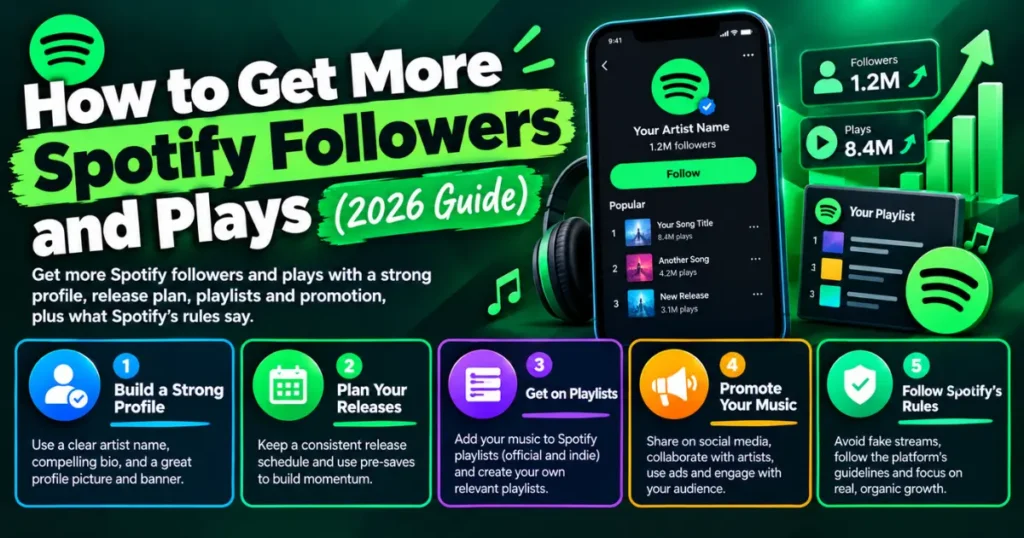
The most reliable way to get more Spotify followers and plays is to claim your artist profile, release music on a steady rhythm, get onto playlists, and send your own audience to your tracks from outside Spotify. Followers follow listeners who like what they hear, so the music and the way people find it matter more than any single number.
This guide covers each step, explains what Spotify’s rules say about artificial streams, and is straightforward about where paid services do and don’t fit.
Followers, plays and monthly listeners: what each means
These three numbers measure different things, and growing one doesn’t automatically grow the others.
| Number | What it measures | Why it matters |
|---|---|---|
| Followers | People who chose to follow your artist profile | They are notified of new releases, and a new release can land in their Release Radar |
| Plays (streams) | How many times your tracks have been played | The most visible sign of whether people like a track |
| Monthly listeners | Unique people who listened to you in the last 28 days | A snapshot of current reach, which moves up and down |
A stream only counts once someone has listened for a minimum length of time. Repeat listens by the same person add plays but not monthly listeners.
Why this matters for growth: plays show interest in a song, followers show interest in you, and monthly listeners show how many people are currently reaching you. A healthy profile grows all three together. Public numbers are also adjusted when Spotify identifies artificial activity, which the section on paid services explains.
Set up your artist profile
A complete profile gives new listeners a reason to follow, and it unlocks Spotify’s own tools. Start with Spotify for Artists, which gives you access to your profile and your listening data.
- Claim your profile in Spotify for Artists so you can edit it and see your stats.
- Use a clear, current artist photo that follows Spotify’s image guidelines.
- Write a short bio that says what you make and who it’s for.
- Add your social links so listeners can find you elsewhere.
- Set an Artist Pick to feature the track or release you most want new listeners to hear.
- Add a Canvas (a short looping video) to your top tracks.
- Build a playlist or two of your own music and music you love, and post them to your profile.
- Add upcoming concerts if you perform live.
These steps cost nothing and make a visitor’s first ten seconds on your profile count.
Plan your releases around discovery
How you release matters as much as what you release.
- Release on a steady rhythm. Regular singles or EPs give your followers and Spotify’s recommendations more chances to find you than a rare album does.
- Schedule the release in advance. Spotify for Artists only shows tools like pitching for tracks that are scheduled but not yet out, so give yourself lead time with your distributor.
- Pitch your song to Spotify’s editors. In Spotify for Artists you can pitch one unreleased song for playlist consideration, and Spotify’s guidance is to do it before release, with at least seven days’ notice and more if you can. Fill in the genre, mood and instruments accurately, since that information also helps Spotify recommend the track.
- Know that placement can’t be bought. Spotify has said no one can pay to be added to its editorial playlists, and its support page says services that promise paid playlist placement violate its terms.
- Use the release to reach your followers. A pitched or scheduled release can appear in your followers’ Release Radar, so growing followers helps the next release.
- Run a pre-save or countdown. Ask your audience to save the release in advance so that it lands in their library on day one.
Treat each release as a small campaign: a date, a plan to tell people, and a way to see what happened.
Get onto playlists the right way
Playlists drive a large share of discovery, but where you get placed matters as much as how many.
| Type | How it works | What to do |
|---|---|---|
| Editorial | Chosen by Spotify’s own editors | Pitch an unreleased song through Spotify for Artists, and keep expectations realistic since slots are limited |
| Algorithmic | Generated from listener behavior, such as Discover Weekly and Release Radar | Earn saves, repeat listens and playlist adds, which tend to feed these |
| Independent curators | Playlists run by people and blogs | Research curators in your genre, pitch a short personal message and never pay for guaranteed placement |
| Your own | Playlists you build and share | Mix your tracks with others, post them on your profile and share them with fans |
A few habits make playlist outreach work:
- Target playlists that fit your sound. A smaller playlist that matches your genre beats a large one that doesn’t.
- Keep pitches short and personal. Say who you are, what the track is and why it suits their playlist.
- Check where you’ve been added. Spotify for Artists shows the playlists your music is on, and Spotify lets you report suspicious ones.
- Avoid placement for sale. Spotify says services that guarantee playlist placement for money violate its terms.
Promote your music off Spotify
Most new listeners hear a song somewhere else first, so send people to it.
- Share short clips. A 15–30 second piece of the song on short-video platforms, with a link to the full track, brings in listeners who would never have searched for you.
- Post consistently on one or two platforms. Pick the ones where your audience already spends time, and show your process, not just announcements.
- Link directly to Spotify. Put your artist link in your bio and use Spotify’s share links and codes on posters, merch and videos.
- Collaborate. A feature, a remix or a shared playlist introduces you to another artist’s audience.
- Play live. Gigs, open mics and live streams turn listeners into followers, especially if you tell people where to find you afterwards.
- Build an email list. It’s the one audience you own, and it’s the best place to announce a release.
- Ask for the follow. After someone says they like a song, send the profile link and ask them to follow so they hear about the next one.
- Say thank you. A short reply to comments and messages builds the kind of fans who share your music.
Where paid Spotify services fit, and Spotify’s rules
Spotify is stricter about this than most platforms, so start with what it says. On its artist support page, Spotify states that paid third-party services that guarantee streams aren’t legitimate, that services advertising streams for payment violate its terms and conditions, and that using them could result in your music being removed from Spotify.
The consequences Spotify describes include:
- Royalties withheld. Money tied to confirmed artificial streams can be held back.
- Public numbers corrected. Monthly listeners and stream counts are adjusted to remove confirmed artificial streaming.
- Playlist removal. Depending on severity, a song may be removed from Spotify playlists.
- Distributor action. Spotify shares reports with labels and distributors, who may issue warnings or, in flagrant or repeated cases, remove content or suspend an account.
- Charges on distributors. Spotify charges labels and distributors per track when flagrant artificial streaming is detected.
Because those consequences land on your catalogue and your distributor account, Spotify is the platform where buying numbers carries the most to lose. Social Boostly’s own Spotify plays page says the same: manual processing, no password and refill availability don’t mean Spotify approves the service, and it doesn’t describe the service as risk-free.
For reference, here is what the Spotify services cost, in USD as of October 14, 2026, from the live Spotify Plays, Followers, Likes and Playlist Followers pages:
| Service | Price per 1,000 | Minimum order |
|---|---|---|
| Plays | $2.50 | 100 ($0.25) |
| Likes | $6.00 | 50 |
| Followers | $14.00 | 100 |
| Playlist Followers | $16.00 | 100 |
The plays page also states that the service does not include guaranteed artist followers, saves, playlist placement, royalties or authentic listener interest, and that delivery starts within 0–60 minutes of payment confirmation rather than finishing by a set time.
If you’re an independent artist, the sensible default is to put your effort into the organic steps above. If you still choose to look at a service, read the scope notes on each page first and keep purchased activity out of any numbers you report to labels, managers or partners.
Measure what matters in Spotify for Artists
Spotify for Artists shows more than totals. Check these every week or two, and change one thing at a time:
| What to check | What it tells you |
|---|---|
| Source of streams | Where plays come from, such as your profile, playlists, search or Release Radar |
| Saves | Whether listeners liked a track enough to keep it |
| Playlist adds | Which playlists feature you, so you can thank curators and find similar ones |
| Audience and followers | Whether new listeners are turning into followers |
| Release engagement | How a new release performs in its first days |
| Location | Which cities and countries are listening, useful for gigs and promotion |
Look for patterns, not single days. If saves are high but followers are flat, ask listeners to follow. If streams come mostly from one playlist, plan the next release so it reaches people beyond it.
Frequently asked questions
How can I get more Spotify followers?
Claim your artist profile, release music regularly, pitch your songs, get onto relevant playlists, and send your existing audience to your profile. Ask listeners to follow after they say they like a track.
How do I get more plays on Spotify?
Make each release a small campaign: schedule it ahead, pitch it, tell your audience, share short clips and link straight to the track. Playlists and saves help Spotify recommend it further.
Can I pay to get on Spotify playlists?
No. Spotify says no one can pay to be added to its editorial playlists, and its support page says services that guarantee playlist placement for money violate its terms.
Is it safe to buy Spotify plays or followers?
Spotify states that paid services advertising streams violate its terms and that using them could lead to removal of your music, withheld royalties and corrected public numbers. No seller can make it risk-free.
How much do Spotify plays cost at Social Boostly?
Plays are $2.50 per 1,000, with a minimum order of 100 for $0.25. The service does not include followers, saves, playlist placement, royalties or authentic listener interest.
Where to start
Begin with the free steps: a complete profile, a release plan, a few well-matched playlists and a steady stream of short clips sending people to your tracks. Check Spotify for Artists every couple of weeks, and keep doing what moves your saves and followers.
If you’d like to look at Social Boostly’s Spotify options, you can read the scope notes and Spotify’s rules on each service page, starting from the Spotify services hub or the full services list. For general guidance on comparing providers, see our guide on choosing a followers provider, or contact the team with questions.
Prices are listed in USD as of October 14, 2026 and may change. Spotify’s rules are as published on its support pages and may change. Results may vary. Platform rules and terms apply.