

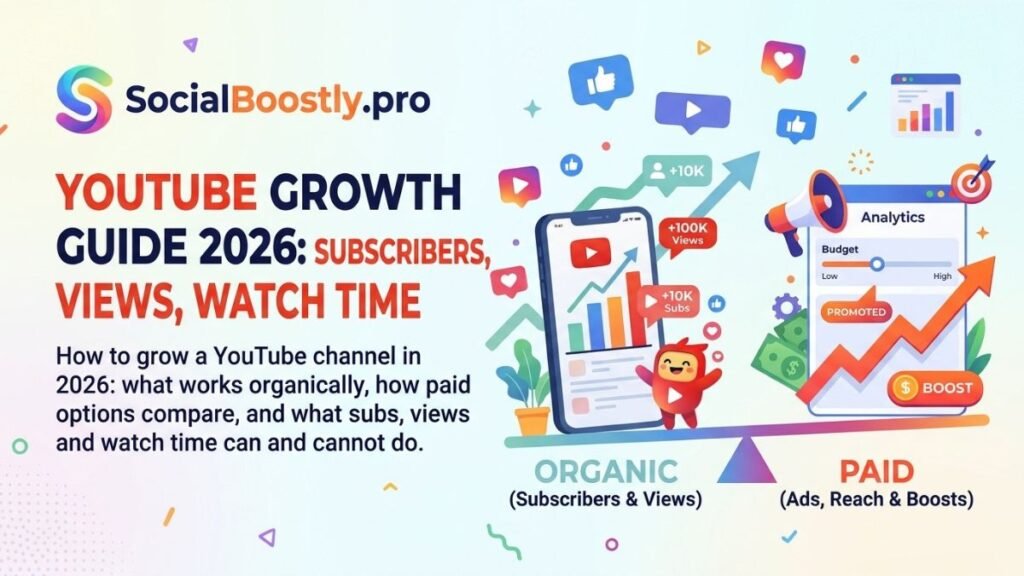
To grow a YouTube channel in 2026, make videos on one clear topic, win the click with an honest title and thumbnail, and keep people watching with a strong opening. Subscribers follow viewers who finish and return. Paid options like ads can add reach, but they don’t replace good videos.
Most YouTube advice splits into two camps. One camp says “just upload consistently and the algorithm will find you.” The other says “buy subscribers and watch hours, then get monetized.” Both skip the part that matters: what actually makes a stranger click, stay and come back.
This guide walks through how YouTube decides what to recommend, the organic habits that grow a channel, what monetization really requires, and where paid options fit. We also sell YouTube services, so we’ll be straight with you about what those can and can’t do. You’ll finish with a 30-day plan you can start this week.
What does “growing a YouTube channel” actually mean?
People say “growth” and usually mean subscribers. But five different numbers sit behind that word, and they move at different speeds:
- Impressions: how often YouTube showed your thumbnail.
- Click-through rate (CTR): the share of those impressions that turned into a view.
- Watch time and retention: how long people stayed, and where they left.
- Subscribers: the people who chose to hear from you again.
- Outcomes: what happened next, such as a sale, a lead, a membership or ad revenue.
A woodworking channel with 2,000 subscribers whose tutorials sell plans every week is doing better than a gaming channel with 50,000 subscribers and a dead comment section. Decide which number you care about before you spend time or money. Subscribers are a result of the other four, not a lever you pull directly.
How YouTube decides what to recommend
YouTube doesn’t publish its formula, and anyone who claims to know the exact weights is guessing. What the platform has said is that its systems try to match each viewer with videos they’re likely to watch and be satisfied with. In practice, a few signals show up again and again:
- Click-through rate. Does your thumbnail and title earn the click from the people it’s shown to?
- Watch time and retention. Do viewers stay, and for how long? A video people abandon in 20 seconds rarely gets pushed further.
- Viewer satisfaction. Likes, comments, shares and survey responses suggest people valued the video.
- Context. Who the viewer is, what they’ve watched before, and whether they’re searching or browsing.
Your total subscriber count isn’t on that list. A small channel can have a video recommended to millions if viewers click and stay, and a large channel can see a video flop if they don’t. If you want the detail on how views are tallied, our explainer on how YouTube counts views is a good next read, and YouTube views vs engaged views explains why a high view count doesn’t always mean a healthy video. For how reactions compare, see YouTube likes vs comments vs watch time.
The practical takeaway: make something people want to click, and something they don’t want to leave. Everything below is a way of doing that.
Organic growth: what actually moves the needle
Organic growth is slower to start and cheaper to run, and it’s the only route that builds an audience that returns on its own. Here’s where we’d put the effort, roughly in order.
1. Pick one viewer and one promise
Channels that try to please everyone usually please no one. Before you upload anything, finish this sentence: “I help ___ who want to ___.” A cooking channel for people who’ve never cooked, a camera-review channel for budget photographers, a coding channel for self-taught beginners. The narrower the promise, the easier it is for YouTube to know who to show your videos to, and for a viewer to know whether to subscribe.
2. Treat the title and thumbnail as half the video
A great video with a weak thumbnail is a video nobody sees. Packaging decides CTR, and CTR decides how many people ever get the chance to watch.
- Write the title first, then make the thumbnail add to it instead of repeating it.
- One clear focal point in the thumbnail. Faces with a readable emotion, a before and after, or one striking object all work.
- Keep it honest. A misleading thumbnail may lift clicks, but viewers who feel tricked leave fast, and that drags down watch time.
- Test and compare. If you have access to YouTube’s thumbnail testing in Studio, use it. If not, change one element at a time and compare against your own past videos.
3. Earn the first 30 seconds
Most viewers decide in the opening seconds. Start with the payoff or the problem, not a logo animation or a long introduction. Say what the video will deliver, show a quick preview, then get going. Cut dead air, tighten every pause, and use pattern changes (a new angle, an on-screen graphic, a sound cue) to keep attention. Check your retention graph in Studio and look for the first big drop. That’s the section to rework.
4. Make search work for you
A lot of long-term growth comes from search, because people look for answers every day. Type your topic into YouTube’s search bar and note the autocomplete suggestions. Those are real queries. Put the main phrase in your title, mention it naturally early in your description, add chapters, and say the keyword out loud in the video. Videos built around a question people keep asking (“how to fix ___,” “best ___ for beginners”) can keep bringing viewers for years.
5. Use Shorts as a doorway, not a replacement
Shorts can put you in front of lots of new people quickly. But a Shorts viewer isn’t automatically a long-form viewer. Use Shorts to introduce your topic, tease a longer video, or answer one narrow question, and point to the full video in the description or comments. Keep the format’s rules in mind too: Shorts have their own monetization requirements, which we cover in our guide to YouTube Shorts monetization requirements.
6. Build sequences, not one-offs
When someone finishes a video, you want them to watch another. Group related videos in playlists, add end screens that point to the logical next video, and mention it in your closing line. A viewer who watches three videos in a row is far more likely to subscribe than one who watches a single video and leaves.
7. Talk to your audience
Reply to comments, especially in the first hours after an upload. Ask a specific question in the video that people want to answer. Pin a useful comment. Use the Community tab for polls and behind-the-scenes updates. This won’t make a video go viral on its own, but it turns viewers into regulars, and regulars are the ones who click your next upload early, which helps it get shown.
8. Pick a rhythm you can keep
There’s no magic upload number. One strong video a week that you can keep up for a year beats three rushed videos for a month and then silence. Choose a schedule, stick to it, and review your numbers every month.
If you’re after more tactics for views specifically, our guide on how to get more YouTube views goes deeper. And if you’re also working on other platforms, the principles in how to grow a social account organically apply across all of them.
What YouTube monetization actually requires
Many creators come to this topic because of the YouTube Partner Program. It helps to know exactly what you’re aiming at, and that the thresholds are about valid activity, not just numbers on a screen.
At the time of writing, YouTube’s program has two entry levels. The lower one unlocks fan-funding features, and the higher one unlocks ad revenue sharing. Both ask for a minimum number of subscribers plus either public watch hours over the last 12 months or a minimum number of Shorts views over the last 90 days. The exact figures can change, so always check YouTube’s own page before you plan around them. We keep our own breakdowns up to date here:
- YouTube monetization requirements
- YouTube Partner Program requirements for 2027
- YouTube Shorts monetization requirements
- How much YouTube pays per 1,000 views
The last one is worth a look before you set expectations, because earnings per 1,000 views vary a lot by topic, audience location and format.
Paid options: what you can buy and what it does
“Paid” covers several different things. These are the ones people actually use, and they behave very differently.
| Option | What you pay for | Best for | Main trade-off |
|---|---|---|---|
| YouTube ads (Google Ads video campaigns) | Views or actions, billed by Google. Cost varies by country, audience and creative | Promoting a product, a launch or a video that already performs well | Stops when the budget stops. Weak creative wastes money fast |
| Creator collaborations and sponsored mentions | A fee, free product or revenue share with another creator | Borrowing trust from a channel your audience already watches | Fit matters more than size. Disclose paid partnerships |
| Promotion off YouTube | Time, an email list, ads on other platforms | Sending existing audiences to a new video | Needs an audience or budget elsewhere |
| Subscriber, view and engagement services | A fixed price per 1,000 subscribers, views, likes or similar | Raising a visible count on a new or empty channel | Doesn’t add real viewers, may drop over time, and goes against YouTube’s policies |
That last row deserves a direct answer, since it’s what we sell.
Where subscriber and view services fit (and where they don’t)
YouTube’s fake engagement policy prohibits artificially increasing metrics such as views, likes and subscribers, and YouTube can remove inflated numbers and act on channels that do it. That’s the platform’s rule, not our opinion, and it’s why we won’t tell you any order is risk-free. We lay out the realistic risks in our comparison of the best sites to buy social media followers and what to check before you pay anyone.
What these services can do is change a visible number. For a brand-new channel, a higher count can make the page feel less empty to a first-time visitor. What they can’t do is make anyone watch, comment, subscribe on their own, or buy from you. They don’t improve how YouTube ranks your videos, and they’re no substitute for the work above.
Watch time needs an extra warning. A purchased watch-time service is not a shortcut to monetization. YouTube decides eligibility using its own rules about valid public watch hours, and nothing a third party sells guarantees you’ll qualify. If monetization is your goal, build the hours with real viewers.
Here are the rates listed on our YouTube service pages, as of November 19, 2026:
| Service | Price | Minimum order | Page |
|---|---|---|---|
| YouTube Subscribers | $22.00 per 1,000 | 100 | YouTube Subscribers |
| YouTube Views | $3.00 per 1,000 | 100 | YouTube Views |
| YouTube Likes | $5.00 per 1,000 | 50 | YouTube Likes |
| YouTube Comments | $30.00 per 1,000 | 10 | YouTube Comments |
| YouTube Watch Time | $50.00 per 1,000 | 1,000 | YouTube Watch Time |
| YouTube Live Stream Views | $4.00 per 1,000 | 100 | YouTube Live Stream Views |
| YouTube Live Stream Viewers | From $12.00 per 1,000 | 100 | YouTube Live Stream Viewers |
To see how it adds up, 1,000 subscribers at $22 per 1,000 is $22, and 5,000 views at $3 per 1,000 is $15. Our social media services price list compares every platform side by side.
If you stream, two of our guides help you choose: YouTube live views vs concurrent viewers explains the two metrics, buying YouTube live stream views vs viewers compares the service types, and how much live stream viewers cost breaks down pricing. For the organic side, see how to get more live stream viewers and how to promote a live event on YouTube and Facebook.
Organic vs paid: a side-by-side view
| Organic | Ads and collabs | Count-boosting services | |
|---|---|---|---|
| Upfront cost | Time only | Budget or fees | Small, priced per 1,000 |
| Speed | Slow at first | Fast while spending | Visible count rises over the delivery period |
| Audience quality | Highest | Depends on targeting | Not a real audience signal |
| Effect on YouTube recommendations | Direct | Direct while running | None on its own |
| Platform-rule risk | None | Low if you follow ad rules | Higher. Against YouTube’s policies |
| Lasts after you stop | Yes | Mostly no | May drop over time |
The pattern is clear. Organic work compounds. Ads rent attention. Count-boosting changes a number. Most channels that grow steadily lean on the first, borrow from the second when they have a video worth promoting, and think carefully before touching the third.
A simple 30-day plan
You don’t need a complicated system. You need a small one you’ll actually follow.
Week 1: Set the foundation.
- Write your viewer-and-promise sentence and pin it to your notes.
- Update your channel name, banner, description and trailer so a new visitor understands the channel in five seconds.
- Research 10 questions your viewer asks, using YouTube’s search suggestions.
- Look at the top three videos of two or three channels in your niche and note what their titles and thumbnails have in common.
Week 2: Publish and learn.
- Upload one strong video built around a real search question.
- Spend as much time on the title and thumbnail as on the edit.
- Publish two Shorts that tease or answer a narrow part of the video.
- Reply to every comment for the first 48 hours.
Week 3: Build the loop.
- Upload a second video that follows naturally from the first, and link them with an end screen and playlist.
- Check the retention graph on the first video and fix what you find in the second.
- Reach out to one creator in a related niche about a collaboration or a shout-out.
Week 4: Review and decide.
- Compare CTR, average view duration and traffic sources with week 1.
- Keep the format and topic that did best. Drop the one that didn’t.
- Decide if paid support makes sense. If a video is already performing, promoting it is usually a better use of money than promoting something untested.
How to measure whether it’s working
Don’t judge by subscribers alone. Open YouTube Studio once a week and compare against your own previous month, not someone else’s channel.
| Metric | Where to find it | What it tells you |
|---|---|---|
| Impressions click-through rate | Studio, Analytics, Reach | Whether your title and thumbnail earn clicks |
| Average view duration and percentage viewed | Studio, Analytics, Engagement | Whether the video holds attention |
| Audience retention graph | Inside each video’s analytics | The exact moment viewers leave |
| Traffic sources | Studio, Analytics, Reach | Whether you’re found through search, suggested videos or Shorts |
| Subscribers gained per video | Studio, Analytics, Audience | Which videos convince people to follow |
| Returning viewers | Studio, Analytics, Audience | Whether you’re building a regular audience |
Compare each number with your last five videos. A rising trend matters more than any single result.
Common mistakes that slow growth
- Buying numbers before building videos. A high count on a channel with nothing worth watching makes the gap more obvious.
- Ignoring the thumbnail. If CTR is low, a better edit won’t save the video.
- Long, slow openings. If retention drops in the first 30 seconds, start with the payoff.
- Chasing every trend. Trends help when they fit your topic. When they don’t, they bring viewers who never come back.
- Changing the plan every week. Give a format at least four to six uploads before judging it.
- Treating watch hours as a purchase. Monetization depends on valid public watch time from real viewers.
- Never checking analytics. The data tells you which videos earn subscribers. Look at it.
Frequently asked questions
How long does it take to grow a YouTube channel?
There’s no fixed timeline. Many channels that upload consistently and keep improving their packaging see early traction within a few months, but results vary widely by niche, video quality and starting audience. Treat the first 90 days as a testing period.
How many subscribers do I need to get monetized?
YouTube’s program has more than one level, and the numbers can change. The ad-revenue tier has historically asked for 1,000 subscribers plus 4,000 valid public watch hours in 12 months or a high number of Shorts views in 90 days. Check YouTube’s current page, and see our monetization requirements guide.
How often should I upload on YouTube?
Upload as often as you can keep up with for a year. For many channels that’s one strong video a week. Quality and consistency beat volume.
Do Shorts help long-form videos?
They can introduce your channel to new people, but Shorts viewers don’t automatically watch long videos. Use Shorts to tease or answer a narrow question, and send people to the full video.
Is buying YouTube subscribers safe?
No order can be called risk-free. It goes against YouTube’s policies, the numbers can drop, and it doesn’t create real viewers or help your videos get recommended. If you’re considering it, read what to check in our guide to the best sites to buy social media followers and review the details on the YouTube Subscribers service page.
What is the best time to upload?
The best time is when your own audience is online. Check the “When your viewers are on YouTube” report in Studio, then test a consistent day and time for a few weeks.
Final thoughts
Growing on YouTube isn’t a trick. It’s a loop: pick a topic people search for, package it honestly, hold attention, learn from the graph, and do it again. Paid options can speed parts of that loop up, but none of them replace it.
Start with the 30-day plan and review your numbers at the end. If a visible boost or extra reach fits your plan, you’ll find exact per-1,000 pricing on our YouTube services page, the full services list, or you can contact the team with questions before you order. Growing on other platforms too? Our Instagram growth guide covers the same organic-versus-paid trade-offs for Reels and followers.
Results vary. Platform rules and terms apply.